Spatial query
Shown when: BIWT found spatial coordinates in your data. If it found none, this screen is skipped — placement will be random.
The question
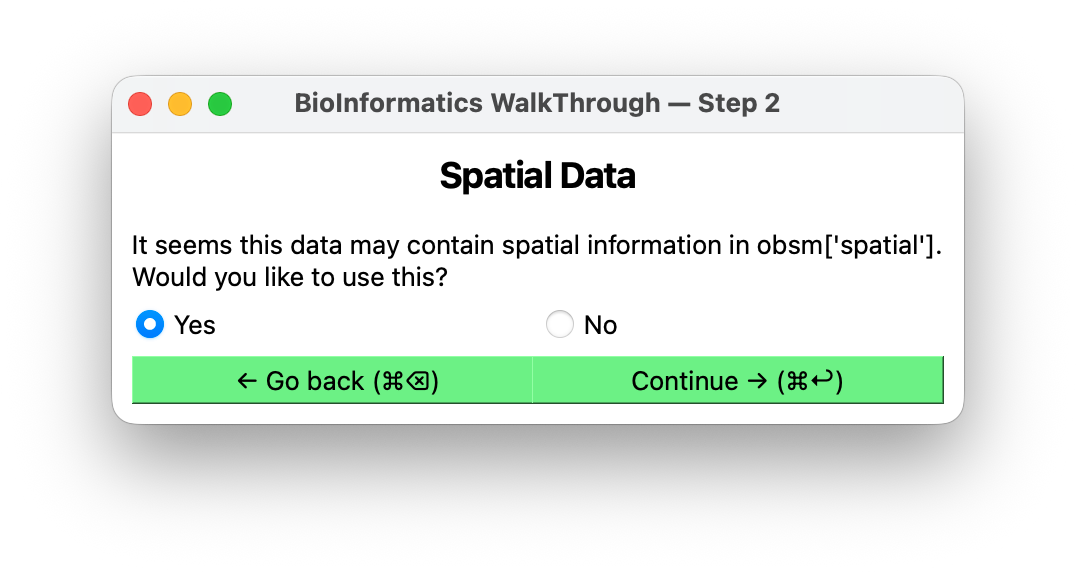
"Use the spatial coordinates from the data?" Yes or no. The prompt names where it found
them: BIWT checks obsm first, then obs/CSV columns.
| Source named in the prompt | Usually holds | Use it? |
|---|---|---|
obsm['spatial'], obsm['X_spatial'], obsm['spatial_coords'] |
The conventional slot for tissue coordinates — Visium, Xenium, MERFISH | Yes — this is what it is for |
Any other obsm key containing spatial or coord |
Whatever its author put there: tissue_coords, but X_umap_coords matches too |
Check the name before trusting it |
obs columns spatial_x, x_coord, coord_x, x_centroid, cell_x (and y/z equivalents) |
Columns whose name says "coordinate" — segmentation centroids, exported spatial tables | Yes |
obs columns x, y, z |
Anything at all — the most generic match BIWT makes | Usually, but this is where an embedding can hide |
obs columns imagecol, imagerow, shown as (image columns) |
Visium pixel positions, flipped to y-up | Yes, but set the scale factor in the domain editor |
Embeddings stored under their conventional names — X_umap, X_tsne, X_pca — are not
matched, so a UMAP sitting alongside real coordinates is never picked up by mistake.
Yes — place cells where the data says
Cells are placed at their recorded positions, uniformly scaled and centered to fit the domain. Relative geometry is preserved exactly: the ratio of any two distances is unchanged.
Consequences:
- Cell counts follow from the data. One cell per row, so the cell counts screen is skipped. You cannot ask for "500 tumor cells" here — you get however many the data has, minus any types you delete at the edit cell types screen.
- The domain editor becomes relevant. How your data's extent maps onto the simulation box is now a real decision, and BIWT will raise it at the positions screen if the fit looks wrong.
No — place cells randomly
Cells are distributed at random within the domain. Their type composition is preserved, but their positions are not.
Consequences:
- You choose the counts. The cell counts screen appears, with four ways to specify how many cells of each type to place.
- Coordinates in the file are ignored entirely.
Which to pick
Say yes when spatial arrangement is part of what you are modeling — tumor–immune architecture, spatial gradients.
Say no when the arrangement is not meaningful, or you do not want it. Two common cases:
- The prompt named a source you do not trust — see the table above. Placing cells at the positions of a dimensionality-reduction embedding gives you a picture of the embedding, not of tissue.
- You want a synthetic population with realistic composition but a controlled size — seeding a simulation with 2,000 cells in the observed proportions rather than the 40,000 in your dataset.
Either way the positions step previews the result, and you can come back and change this answer.