Cluster column
Shown when: you are not doing spot deconvolution.
The question
A dropdown lists every column in your data's metadata table. You pick the one holding cell-type labels.
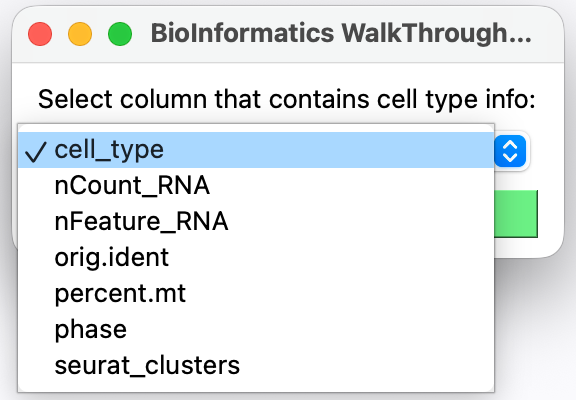
Everything downstream — which types exist, what you can merge, how many cells of each go into the domain — derives from this column.
Picking the right column
Typical candidates in a Seurat or Scanpy object:
| Column | Usually holds | Good choice? |
|---|---|---|
seurat_clusters, leiden, louvain |
Numeric cluster IDs (0, 1, 2, …) |
Only if you have not annotated them yet |
cell_type, celltype, annotation |
Human-readable labels (Tumor, CD8 T cell) |
Usually what you want |
orig.ident, sample, batch |
Which sample the cell came from | No — this is experimental design, not cell identity |
predicted.id |
Labels transferred from a reference | Yes, if that is your annotation |
If you pick a numeric cluster column, you get cell types named 0, 1, 2. You can give
them real names at the rename step — but if you already have an
annotated column, use it and save yourself the mapping.
Not sure which column is which?
Inspect the object before you start. In Python, adata.obs.head() and
adata.obs.nunique() will tell you quickly which columns hold a small number of
repeated string values — the signature of a cell-type annotation. In R,
head(seurat_obj@meta.data).
What happens next
BIWT extracts the unique values from your chosen column as the initial cell-type list, and records which cell has which label. Both feed the edit cell types screen.
If the spot deconvolution question was asked, a Go Back button is available here so you can change that answer.
Next
Spatial query → if your data has coordinates; otherwise edit cell types →.