Edit cell types
Shown when: always.
The question
Every cell type found in your cluster column is listed alphabetically with three options: Keep, Merge, or Delete. By default all are kept.
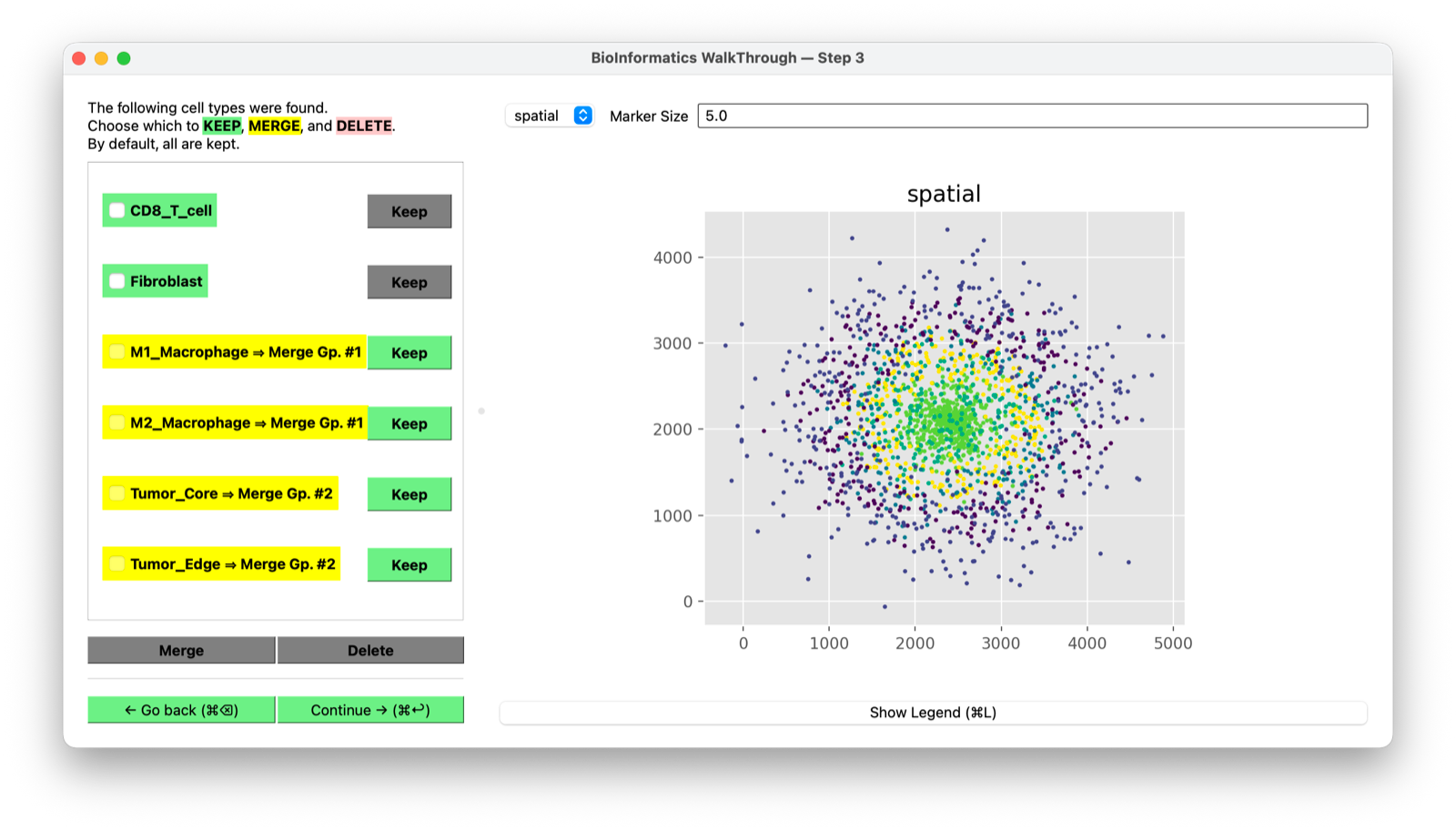
When your data has spatial coordinates, a scatter plot sits alongside the list. The dropdown
above it switches between available representations — spatial plus any dimensionality
reductions your object carries — and Marker Size is worth turning down on dense data.
Show Legend (⌘L) opens the color key in a popup.
Keep
The default. The type survives into the output as its own population.
Merge
Combine two or more types into one. You pick a merge target, and every merged type collapses into it.
Single-cell analyses routinely produce more clusters than a simulation needs — eight T-cell subsets, four macrophage states, three fibroblast populations. If your model does not distinguish them, merge them.
Typical merges:
CD8_effector,CD8_memory,CD8_exhausted→ oneCD8_T_cellpopulationM1_macrophage,M2_macrophage→macrophage, if polarization is a simulation output rather than an input- Several numeric clusters that annotation showed to be the same cell type
A merge with only one partner dissolves
If you set up a merge and then remove all but the target, BIWT quietly turns it back into a Keep. A merge of one thing is not a merge.
Delete
Drop the type from the output entirely. Its cells do not appear in the result at all.
Use this for populations that are artifacts or are irrelevant to the model: doublets, low-quality clusters, ambient-RNA clusters, or tissue types outside the scope of what you are simulating.
Thinking about it the right way
Ask what your model actually distinguishes. A cell type in a PhysiCell simulation is a set of phenotype parameters — motility, secretion, mechanics, death rates. Two clusters that will receive identical parameters are the same cell type as far as the model is concerned, however distinct their transcriptomes. Merge them.
Conversely, do not merge two populations you intend to give different behavior, even if they are transcriptionally similar.